

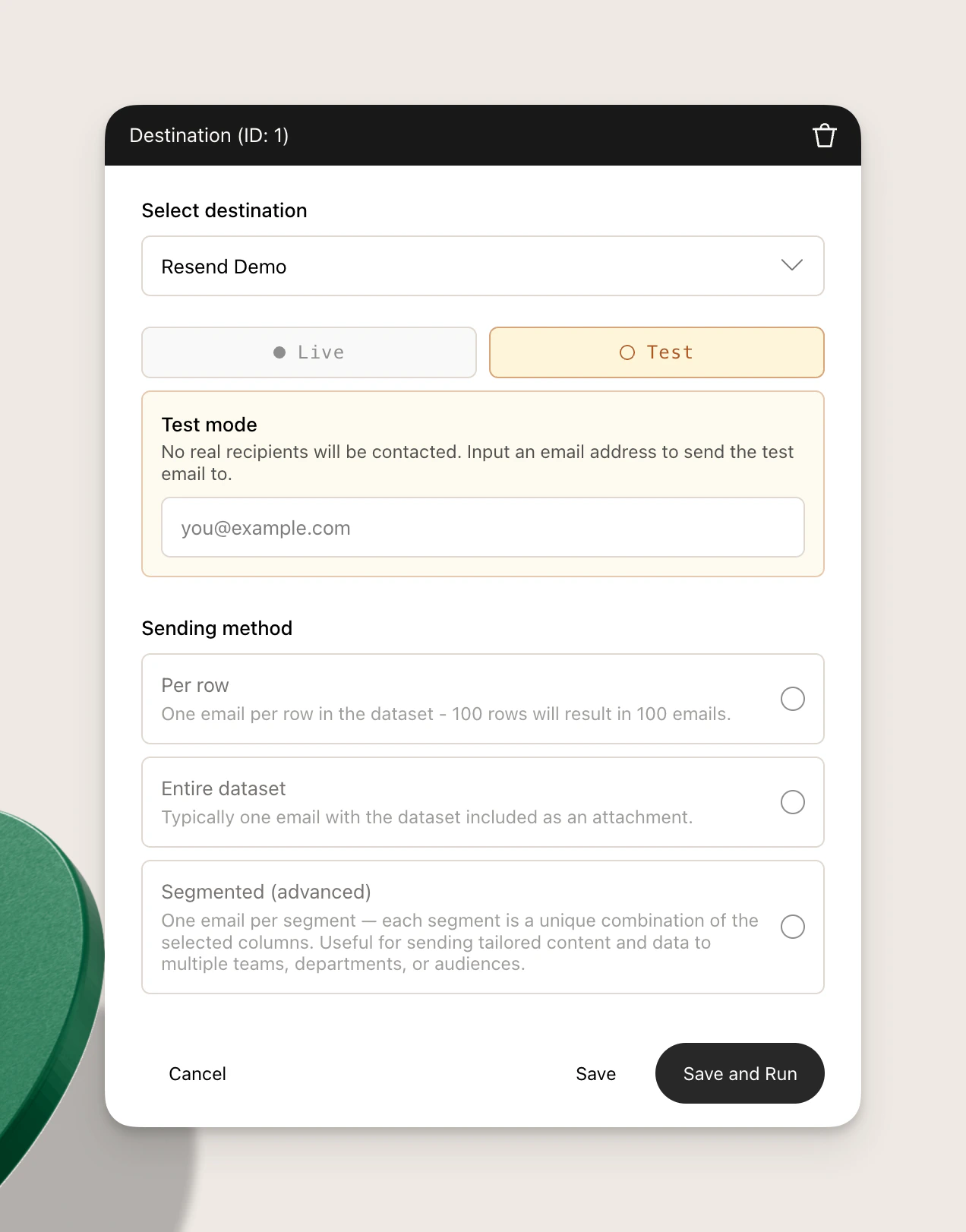
Test mode and Live mode
At the top of the form you choose Test or Live:- Test (default): Real addresses from your data are not used as recipients. Enter a test email address; when the tool runs, a single preview is sent only to that address. The subject line is prefixed with
(TEST)where applicable. The Canvas still shows an info message summarizing what would happen in Live mode (row counts, segment counts, columns used, and whether an attachment is included). - Live: Email is delivered to the recipients defined by your sending method (column values or typed addresses). The test address field is hidden; CC and BCC from your configuration are honored.
In Per row and Segmented test mode, the preview uses the first row or first segment only—so you see one example email, not one per row or segment. Entire dataset test mode sends one preview that uses the full dataset in the body (including the data table placeholder) and attachment, but still delivers only to your test address.
Sending method
Pick how you can . The rest of the form appears after you choose a method.Per row
One email per data row (100 rows → up to 100 sends, rows with no valid recipients may be skipped).- To: Choose the column whose cells hold recipient addresses. Each cell may be one address or a comma-separated list.
- CC / BCC (optional): Same rules, each as an optional column.
- Subject: Syntax-aware; you can reference any column from the row. Use double quotes around literal text where the editor expects it.
- Email body: HTML editor with column and parameter references. You can insert the DataTable snippet: a small inline table (first 20 rows × 10 columns of non-recipient columns) substituted into the message.
- Attachment (optional): CSV or Excel (.xlsx). Each attachment contains that row’s data (recipient columns are omitted from the file).
Entire dataset
Typically one email for the whole run.- To: Type addresses directly (one or comma-separated). CC and BCC are optional free-text fields with the same format.
- Subject and body: Plain configuration for that single send—no per-row column references in the subject (the dataset is one blob). The body still supports parameters, the DataTable placeholder, and HTML.
- Attachment: The full dataset as CSV or XLSX when selected.
Segmented (advanced)
One email per segment, where a segment is each distinct combination of the columns you select under Segment data and recipients.- Segment columns: Multi-select. Values from these columns are constant within a segment, and only these columns are available in the subject syntax picker (plus literals).
- To / CC / BCC: Column-based, like Per row. Within each segment, all unique addresses found in that segment’s rows for the To column receive one shared email (and similarly for CC/BCC).
- Body: You can reference segment columns, parameters, and DataTable; the table and attachment reflect that segment’s rows only.
Attachment filename
If you choose CSV or Excel, you can optionally set Attachment filename with the same syntax rules as the subject where column references are allowed (per mode). If you omit it, a sensible default name is used.Limits and validation
- The email body must contain enough visible text after HTML is stripped (minimum length is enforced in the form).
- Large attachments are capped (very large exports may require fewer rows/columns upstream or CSV instead of Excel). If a run hits provider message-size limits, reduce data or drop the attachment.