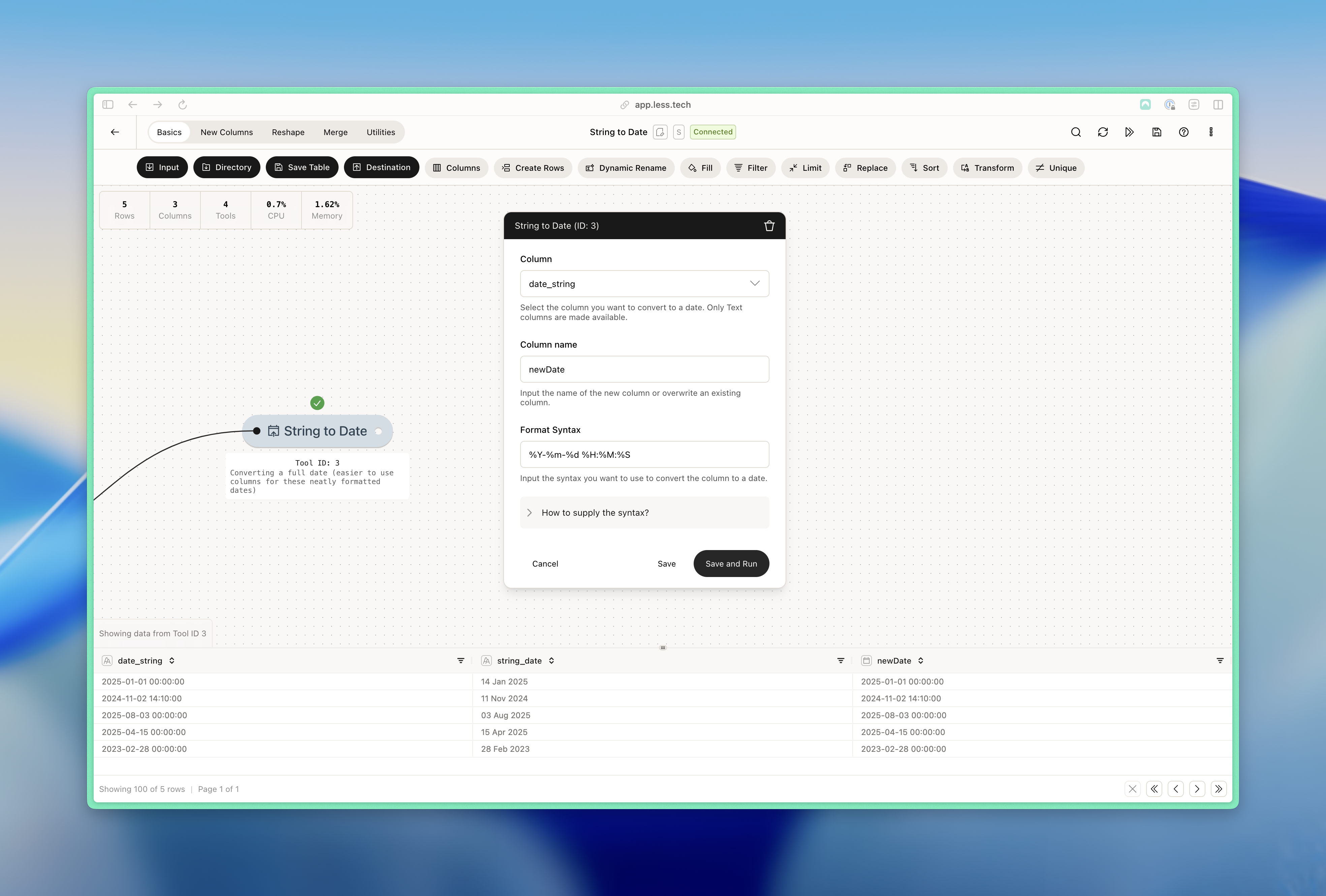
Turn weird date formats into date/datetime formats
| Format | Description |
|---|---|
%a | Weekday as locale’s abbreviated name: Sat, Sun |
%A | Weekday as locale’s full name: Saturday, Sunday |
%w | Weekday as a decimal number where 0 is Sunday |
%d | Day of the month as a decimal number: 01,02, …, 31 |
%b | Month as locale’s abbreviated name: Jan, Feb |
%B | Month as locale’s full name: January, February |
%m | Month as a zero-padded decimal number: 01,02,…,12 |
%y | Year without century as decimal number: 00,01, …,99 |
%Y | Year with century as a decimal number: 2011, 2012 |
%H | Hour (24-hour clock) as decimal number: 00,01, …, 23 |
%I | Hour (12-hour clock) as decimal number: 01, 02, …, 12 |
%p | Locale’s equivalent of either AM or PM: AM, am, pm, PM |
%M | Minute as a zero-padded decimal number.: 00, 01, …, 59 |
%S | Second number (00–60), zero-padded to 2 digits |
%f | Microsecond as a 6 digits number: 000000, 000001, …, 999999 |
%z | UTC offset in the form ±HHMM[SS[.ffffff]]: +0000, -0400, +1030 |
%Z | Time zone name: UTC, GMT |
%j | Day of the year as a decimal number: 001, 002, …, 366 |
%U | Week number of the year (Sunday as the first day of the week: 00, 01, …, 53 |
%W | Week number of the year (Monday as the first day of the week): 00, 01, …, 53 |
Input Column Name
Select Column to Parse
Input the Format of Your Columns
Strange Column to Date format
%b corresponds to Jan/Feb/Mar, the %d corresponds to the day of the month and the %Y corresponds to the year.Note how we are connecting these with the actual symbols from your column - i.e. - and ,.